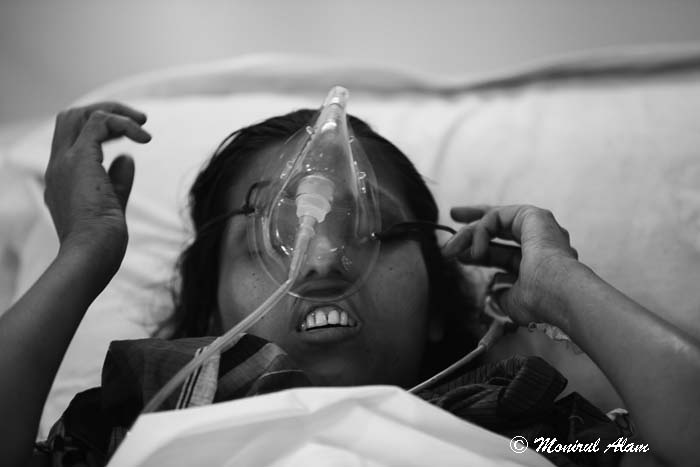
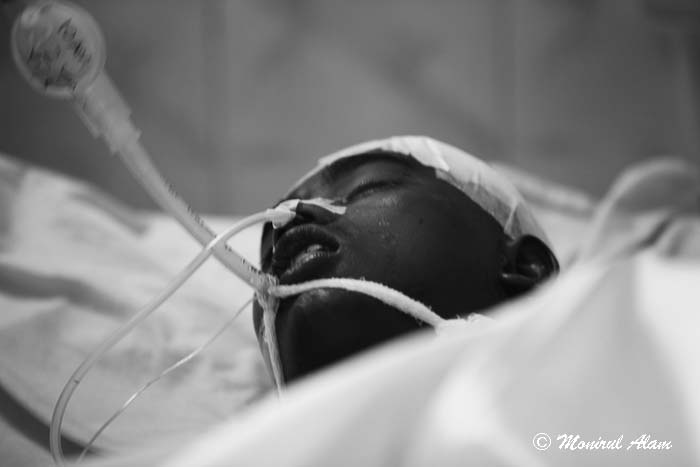
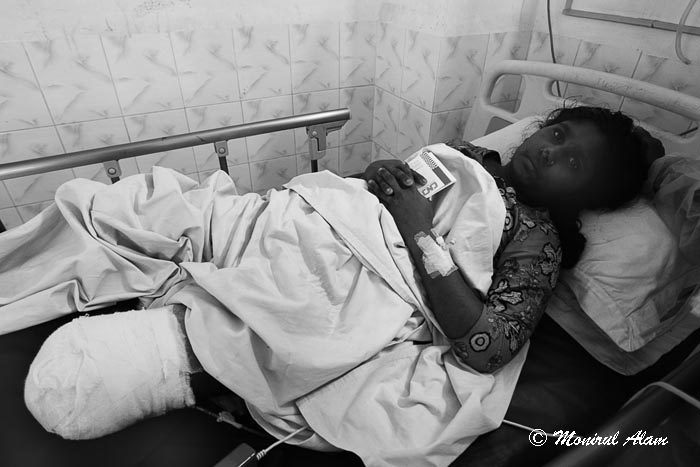
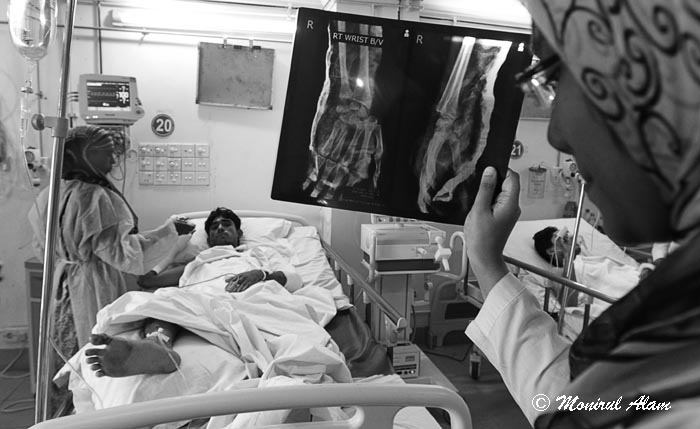
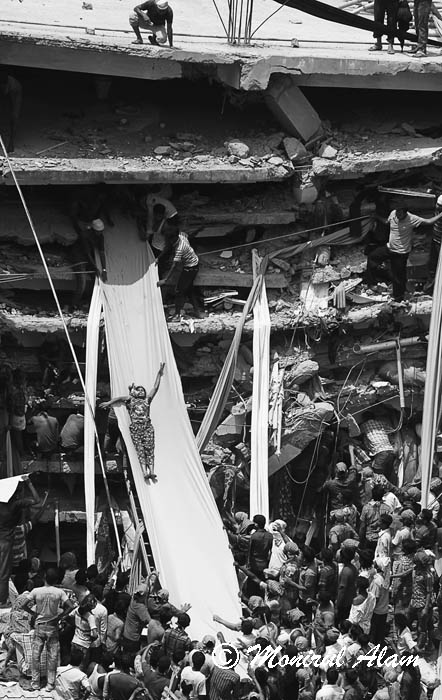
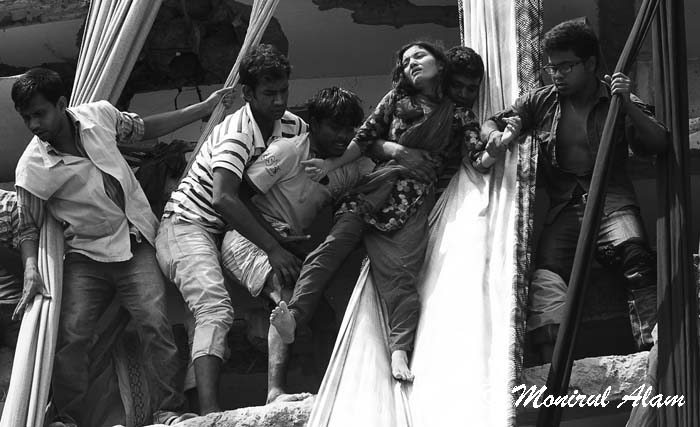
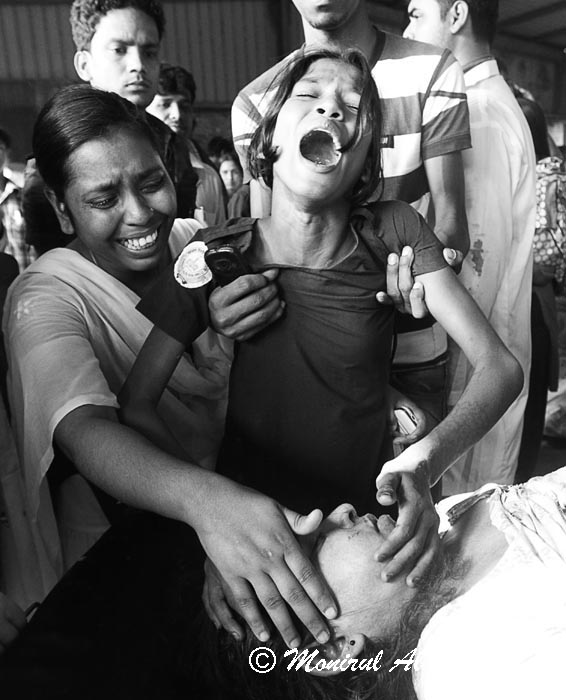
Pakhi Begum 25, lost both of her legs in the Rana Plaza building collapse. Pakhi works as a machine operator on the fifth floor of the nine-storey building when it collapsed in April 24, 2013. Her legs trapping under the concrete bar, her husband Jahangir Alam 30, and her two daughters said, we are very happy to see her alive, when lots of people were either missing or dead. Several injured victims like Pakhi they are admitted in Savar and Dhaka different hospital for the treatment here is some critical patient who are admitted at Enam Medical College and Hospital in Savar.
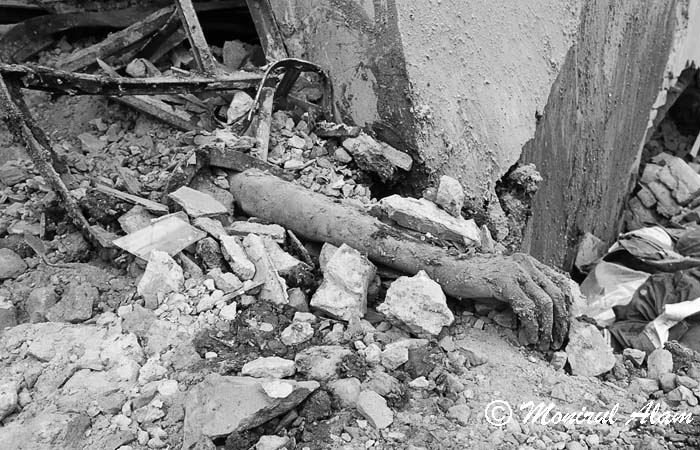
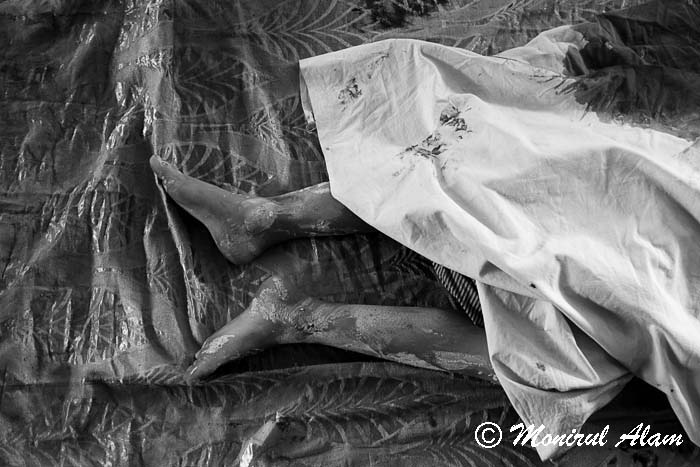
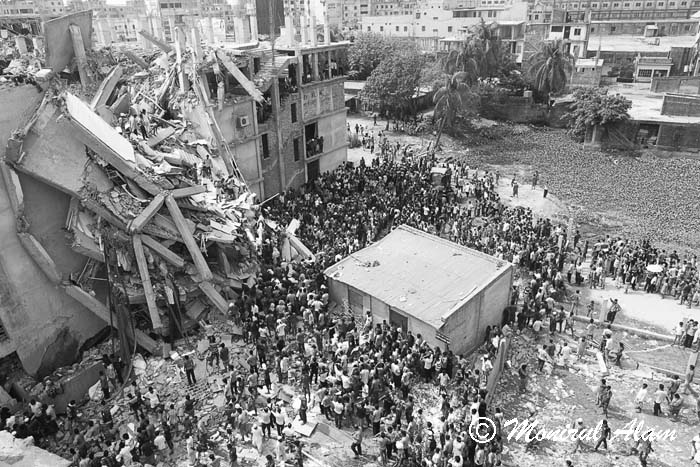
Reports state that the death toll rose over 540 ( update 4 May, 2013) and many more still missing, according to a senior military official leading rescue operations at the spot. 52 bodies were recovered on 03 May 2013 after the eight-storey building Rana Plaza housed mostly garment factories which collapsed on 24 April 2013.
Bangladesh’s garment industry has grown rapidly during the last decade. The Ready Made Garment, RMG, sector contributes 76% of the total export earning of Bangladesh. Recently an eight-story block housing factories and a shopping center on the outskirts of the Bangladeshi capital Dhaka collapsed on April 24 morning killing at least 430 more ( update, 2 May 2013) people. Rescuers fear the death toll may rise significantly. Local citizen, fire fighters, army personnel,police, volunteers joined to rescue them. A number of workers garment factories in Savar alleged that they were forced to work in the morning. Most of the victims who have been rescued from under the debris in the afternoon are dead. The injured and dead victims were rushed at Enam Medical College and Hospital in Savar to hand over victims’ relatives for burial.
Copy Right Notice:
All images and text in this site is copyrighted. Please don’t use any image without written permission. Please contact witnessphoto@gmail.com
In the story, a popular Bangladeshi comic character called Meena (girl), desire for an education but initially has to stay at home to help with the housework. But by the end of the story, Meena’s relatives realize the value of education and the earnest young girl heads to school with her younger brother. The focus on education is evident among policymakers across Bangladesh who are taking measures to achieve a 100 per cent literacy rate within the next decade.
As per the latest literacy survey report of Bangladesh Bureau of Statistics (BBS), the country’s literacy rate of the population aged above 15 reached 59.82 per cent while the illiteracy rate is 40.18 and the literacy of women is 55.71 per cent.
The education system and structure of Bangladesh has three major stages-primary, secondary and higher educations. Primary education is a 5-year cycle while secondary education is a 7- year one with three sub-stages: 3 years of junior secondary, 2 years of secondary and 2 years of higher secondary. The private schools also receive strong financial support from the state. The tertiary education (3-5 years) is provided through universities (31 public and 51 private universities) and affiliated colleges under supervision of University Grants Commission. Establishment of private universities has gained momentum in recent years. At all levels, students can choose the medium of education from Bangla or English.
The constitution is the fundamental law of the country it serves as a framework of all others laws. According to the Bangladesh Constitution article 17 Free and compulsory education. The State shall adopt effective measures for the purpose of –
a) establishing a uniform, mass-oriented and universal system of education and extending free and compulsory education to all children to such stage as may be determined by law; b) relating education to the needs of society and producing properly trained and motivated citizens to serve those needs; removing illiteracy within such time as may be determined by law.
This project was a challenge for me as I had to document the subject in a different way than I did before and continue in upcoming days. I feel this challenge has taken the whole project to a new level.
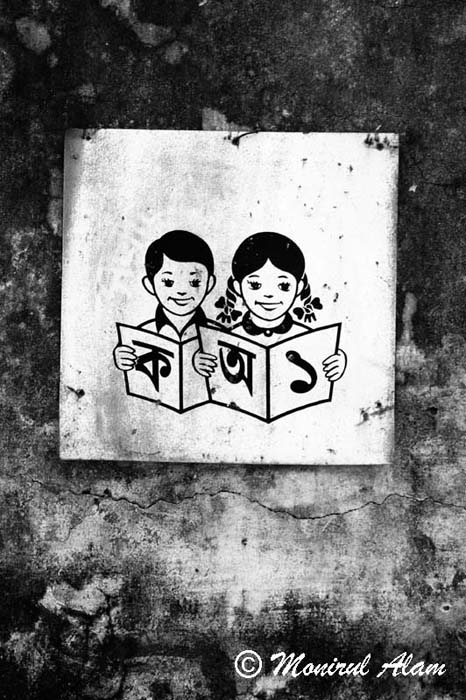
An artist makes a school education logo which is display on the school wall its logo is widely use in Bangladesh. As per the latest literacy survey report of Bangladesh Bureau of Statistics (BBS), the country’s literacy the literacy rate of the population aged above 15 reached 59.82 per cent while the illiteracy rate is 40. PHOTO Nov. 18, 2009 Dinajpure Bangladesh.
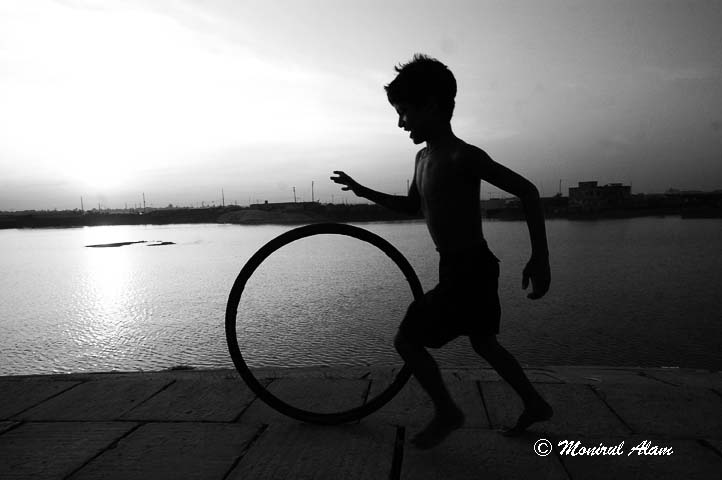
A Bangladeshi child play with his rickshaw tires on the street of Dhaka after he finished his school, Prime Minister Sheikh Hasina says her government has undertaken necessary plans to free the country of illiteracy by 2014. PHOTO Oct. 27, 2005 Dhaka Bangladesh.
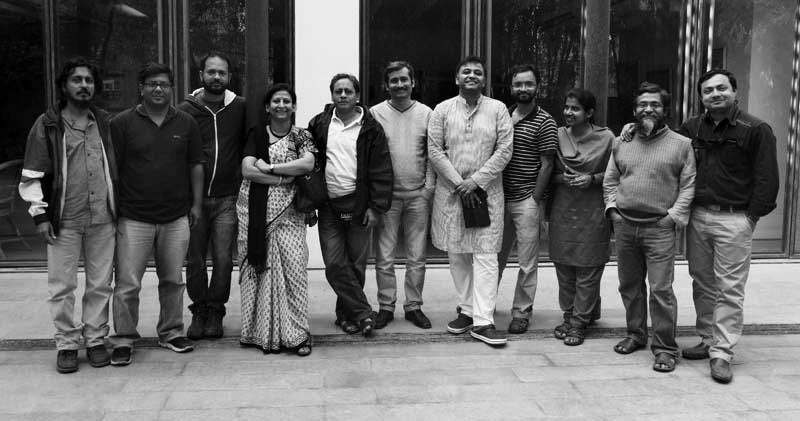
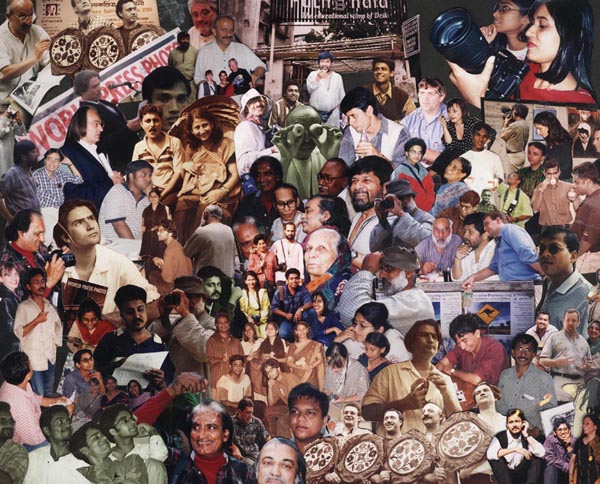
Groups of Pathshala teachers place for photos in front of Bengal Cafe with HASIB on 19 February 2013. Hasib Zakaria, former vice principal of Pathshala South Asian Media Institute recently leave Bangladesh to the Australia with his family for several years to finish his PhD. We all Pathshala teachers acknowledge him. Photo Credit: Bengal cafe staff
The images of the surrounding things are transmitted to senses, and the senses transmit them to the organ of perception, and the organ of perception transmits them to the “Sensus Communies” and by it they are imprinted on the memory, and are retained there more or less distinctly according to the importance or power of the thing given . . .
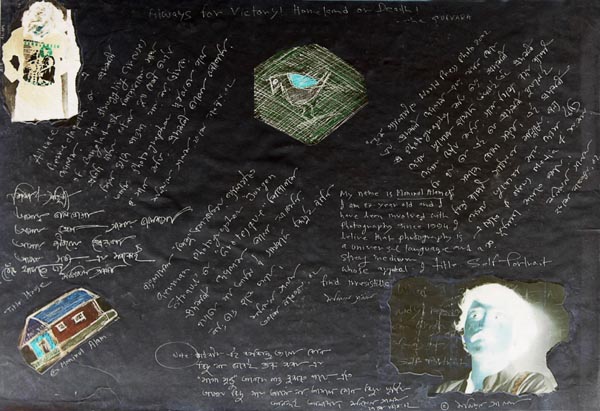
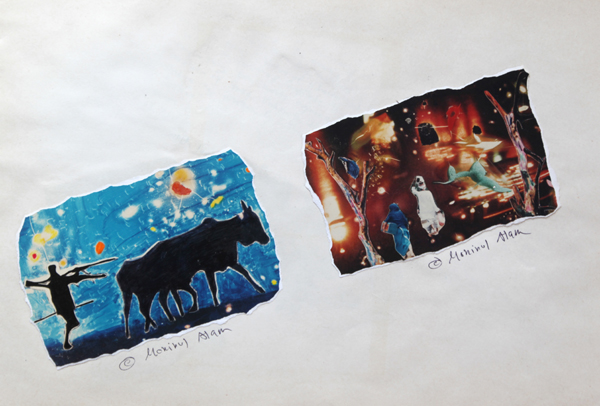
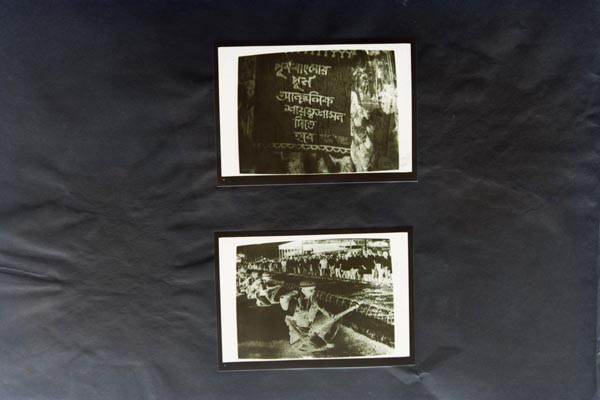
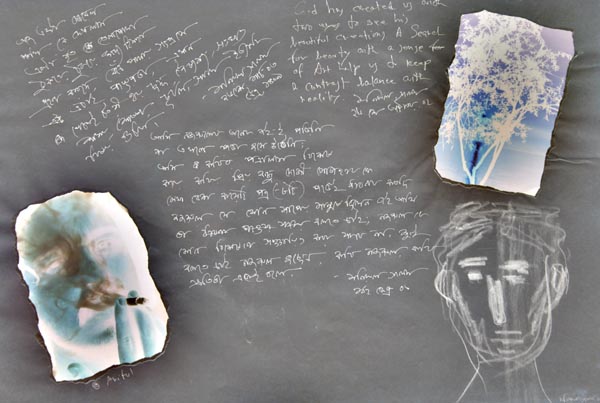
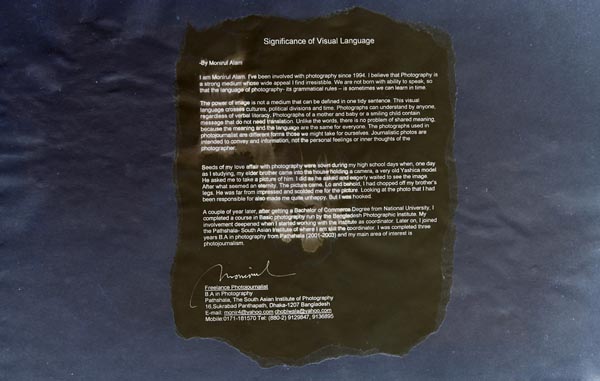
During my photographic graduation degree studies since June 2000 to July 2003 at PATHSHALA, South Asian Media Academy in Bangladesh, I used a homemade scrap book like a diary where I written my thought, sketch, Images, notes etc.
One of my teacher Kirsten Clair ( British ) several time told us maintain diary but I am not too serious about it here I am remember my another teacher Shahidul Alam ( Bangladeshi) said studies never ended, it should continue until your death. Several time several countries master photographer’s / photojournalist’s came to Pathshalala and they conduct a workshop, sharing their works and thought, during our workshop we the students of Pathshala learned more things like technique, aesthetic, presentation, some time we debate our thought with our guest lecture it is rally the good time where we spent, finally we know the importance of visual language and applied our leaving lives.
Here I share one thought, HOW TO LEARN THE VISUAL LANGUAGE it is more important rather than your traditional studies. According to the note books of Leonardo da vince art study, as a visual artist must learn how the eye functions, how the shapes, size and recession of object that are put in its way can be co-ordinate. The play of light on their surfaces; he must also study their structure and life . . .





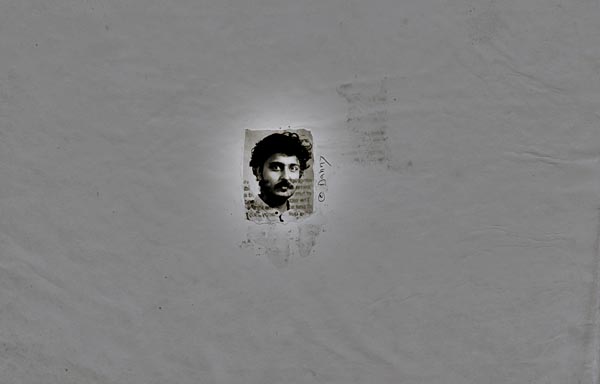
 MONIRUL ALAM