The Conflict between tiger and human has to a new level in the mangrove forest of the Bangladesh.Thirty people were killed by tigers last year and three tigers by people. Since Cyclone Sidr [November 2007] and Cyclone Aila [May 2009], when 1,000 people who lived near to the water had their homes flooded and were forced to move inland. Hungry people now risk facing a tiger attack everyday when they go into the forest looking for food. On February 6 in southern Sundarban. A Bengal tiger had just killed a 40-year-old woodcutter called Mabud, deep in the mangrove forest when he was collecting firewood in the area of Char-shesher. One villager told me ‘We enter the jungle searching for food and the tiger kills us . . . the tiger comes to our village, we kill the tiger’.
I took these photos on February 6 in southern Sundbaran . A Bengal tiger had just killed a 40-year-old woodcutter called Mabud, deep in the mangrove forest when he was collecting firewood in the area of Char-Shesher. One of his fellow woodcutters, Abul Sarder, told me that five of them entered the jungle to collect firewood and suddenly a tiger attacked them. ‘When we had escaped we realised that Mabud had not. We tried to save him but failed to fight off the tiger.’
One of the world’s largest tiger populations could disappear by the end of this century as rising sea levels caused by climate change destroy their habitat along the coast of Bangladesh in an area known as the Sundarbans.
-Recent study of WWF
The Sundarbans is a UNESCO world heritage site spread across 3,700 square miles (9,583sq km) in Bangladesh and another 2,400 square in India- the Ganges river delta, across the border between India and Bangladesh. It is home to an estimated 440 Bengal tigers, according to a joint Indian and Bangladeshi survey done in 2004.
Since a Cyclone Sidr and Aila the conflict between tiger and human has risen to a new arena- highlighting the environmental threats to this unique habitat. Climate Change is simply double edged the problem. Frequently sea-depression, cyclone and storm-rushes, widespread riverbank erosion, salinity interruption, raised high tied and long-lasting summer has increased the vulnerability in alarming level. After nine month of cyclone Aila thousand of people settle down on the embankment and leaving inhuman life that lost their home and land which is flooded with seawater. Hunger people now enter the forest every day and regular facing tiger attack.
“We enter the Jangle for searching food and the tiger killed us . . . beside . . . the tiger came to our village we killed the tiger. The situation is endangered now. We need to be a good solution.”
-Abul Sarder, Villager who narrowly escape from the tiger attack
A wood-cutter was killed by a man-eating Bengal tiger in Bangladesh’s southern Sundarbans forest this month February 2010. The tiger killed Mabud 40, deep in the mangrove forest where collecting firewood in the area of char-shesher. Abul Sarder said, we five people enter the Jangle for collecting firewood suddenly the tiger attacked us- we narrowly escape but Mabud is not! We tried to safe him but failed from the tiger attack.
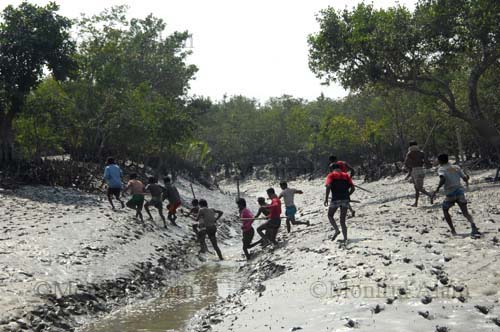
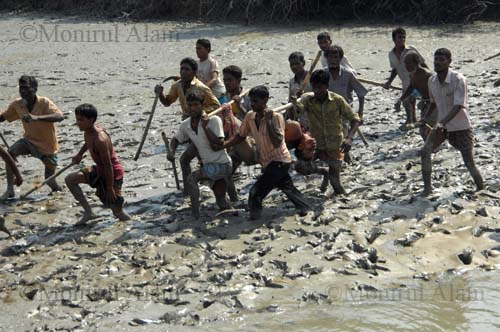
We back to village and come again more than hundred-twenty people with stick, hand through bomb and local weapon to snatch Mabud dead body from the tiger, at last we collect his body, but we afraid, may be the hunter could arrive our village for searching his hunt. He also said Mabud live in village Burigualini under the district of Satkhira. Abul Sarder also said we knew the dangers of the forest, but we couldn’t do anything else to survive. Because our embankments had collapsed three times within last two years, we are the worst victims by the climate change.
Since the 1980 to 2010 Tigers have killed 116 people and villager have killed 7 tiger within 11 years in the Sundarbans under the district of Satkhira according to forestry officials.
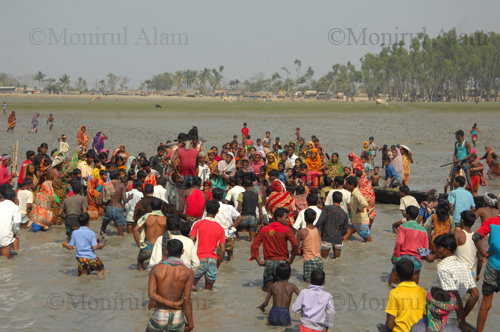
Sundarban,Satkhera February 2010-Villager enter the jungle for searching Mabud body-Copy Right Monirul Alam Sundarban,Satkhera February 2010-At last they found him and carrying very first to escape once more attack - Copy Right Monirul Alam Sundarban,Satkhera February 2010- Curious villager to see Mabud body- Copy Right Monirul Alam

 MONIRUL ALAM