The Daily Star News paper published my photo feature Climate Refugee of Bangladesh to their Monthly publication FORUM Vol. 4 Issue 10 October 2010. Please see see the link http://www.thedailystar.net/forum/2010/October/p_feature.htm
and would like to request send your opinion.
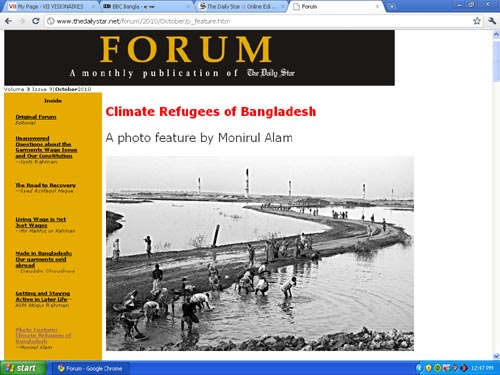
Climate change has touched every corner of the world and every aspect of our lives. As the global temperature increases, its impact will become even more extreme. As part of the initial effects of climate change, the world is already facing food and fuel crisis. The World Bank and IMF have sounded a more serious alarm: 100 million people in low-income countries will be pushed deeper into poverty.
In Bangladesh, we are experiencing rice crisis firsthand. The long queues in front of the subsidised rice sale centres are an indication of the impending disaster: 30 million people will face starvation.
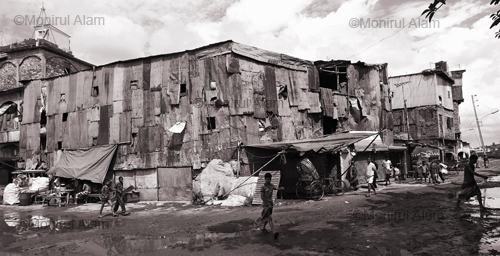
Natural disasters like SIDR, constant river erosion, drought and flood have led to mass migration of people from the countryside to the cities. The migrants were lured by visions of money, food and a better life, but many of them till now have failed to realise their dreams. As a consequence, the rural poor have become the urban poor.
During the course of documenting the state of poverty in urban areas of the country, my investigation finally led me to the plight of the numerous climate refugees in Dhaka city. These are but a few glimpses of a much larger picture.
Thus, indigenous peoples have become the most marginalized and vulnerable group in the country of Bangladesh in its thirty eight years of independence. There is no constitutional recognition of the indigenous peoples of Bangladesh the issue of the identity of the indigenous peoples of Bangladesh has led to much debate and controversy, and on occasions has brought indigenous leaders and government officials into sharp disagreement.

They are only referred to as “backward segments of the population”.
My project is a visual and narrative documentation of this Indigenous people express their daily life and their traditional and cultural condition in the society.
I am using photography not only as a means of evidence, but also a link for the imagination.
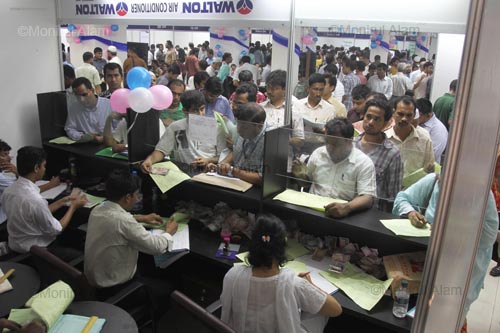
To me its a beautiful concept, when I visit the gallery and to see the exhibition remember my childhood, I read a holly Qoran using a (Rahel a stand for the Qoran) bookstand.
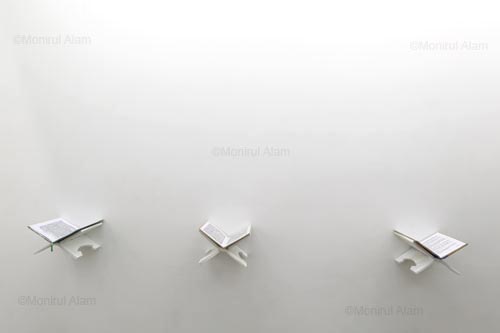
In this series represent a visible sign of Islam. Wakil bhai’s other works is really thinkable and conceptual,I really appreciate his Art.
Hear i say one things as an photojournalist Art/Picture never make it, a truth Art it self born like new born babies.
Dhaka Art center organized a week long solo Art exhibition title Book’s U Can Read by artist’s Germany residents Wakilur Rahman.
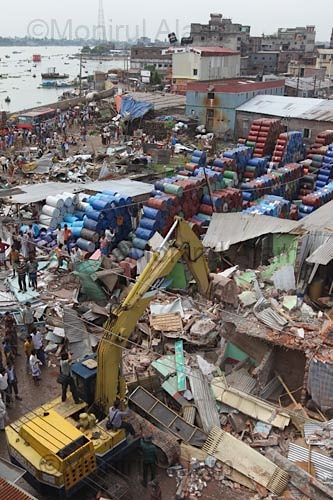
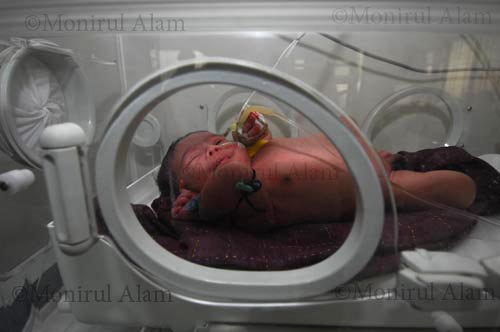
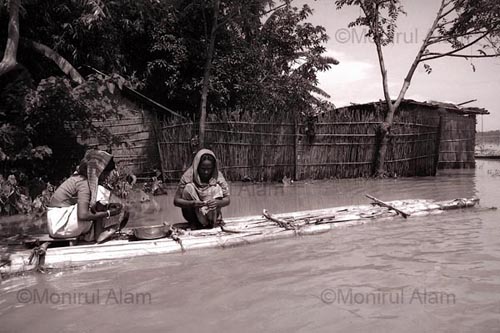
Climate change touches already every corner of the world and every aspect of people’s lives. As the global temperature increases, its impacts will become even more extreme. The impact of climate change world is already facing food and fuel crises. World Bank and IMF have sounded a larger alarm push 100 million people in low-income countries deeper into poverty. Bangladeshi is a country that stands to be one of the first to suffer from global climate change, and the time to act is now. Analysts say it could trigger a migration the size of which the world has never before seen. Some of the big questions remain unanswered. I began to document of marginal condition in my own country. Increasingly severe floods, cyclones and other climate-related changes have already forced the migration of many
Note: Please click the link page to see the full stories and send your opinion
http://monirul.photoshelter.com/gallery/Peoples-Struggle/G00008AklnLsjWBs
 MONIRUL ALAM