Country wide shutdown call BNP

© Monirul Alam

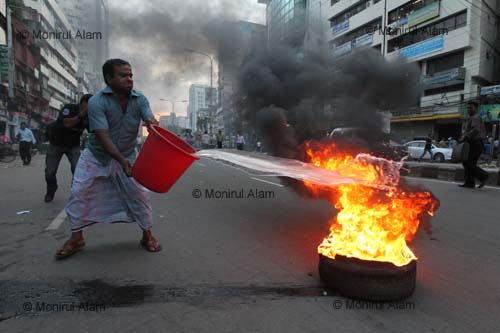
 A shopkeeper throws water to control fire after Bangladesh Nationalist Party or BNP activists set the fire to drum up support for their nationwide strike in Dhaka on 21 September. Nationalist Party and their alliance call nationwide strike to protest against fuel price hike. Dhaka, September 2011. © Monirul Alam

Islamic party clash turn violent in Bangladesh


© Monirul Alam

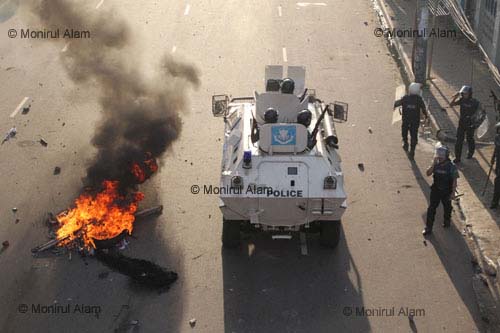
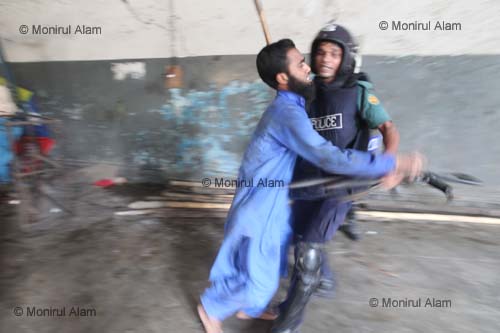
 The street scene of Dhaka during the clash between Jamaat-e-Islami activists and police at Kakrail in the Dhaka 19 September 2011.  Jamat-e-Islami activities set fire to at least 28 vehiles including a prison van and a police jeep after  the clash erupted when the Jamaat activities tried to bring out a procession as part of its countrywide demonstrations demanding immediate release of their top leaders. Dhaka, September 2011. © Monirul Alam

© Monirul Alam

Strong earthquake in Bangladesh

© Monirul Alam

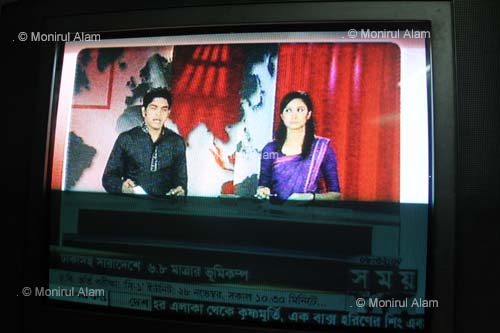
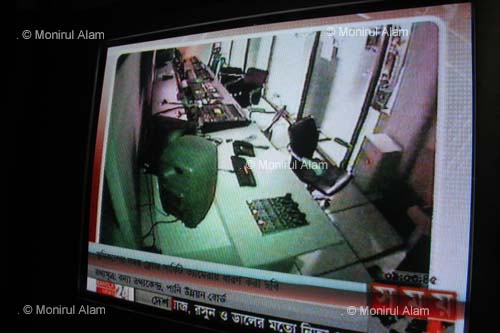
On the earthquake time a private news TV channel Somoy news room is shaking alongside the news presenter is continue their news and other side of the room is empty, a few of panic-people left from the room.  A magnitude-6.8 earthquake was felt across the country evening on Sunday, shaking buildings in the capital and elsewhere.   Panic-stricken people run out high-rise-buildings to the streets in Dhaka. Dhaka, September 2011. © Monirul Alam

© Monirul Alam

Bangladesh jails 182 soldiers for 2009 Mutiny

© Monirul Alam

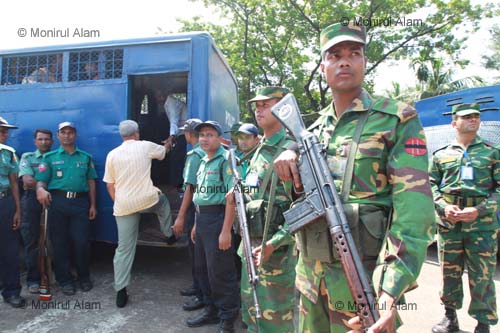
 Bangladesh border guards attend a special court for their final trile  is in Bangladesh Border guard headquarter at Pilkhana yesterday on 12 September. One hundred and eighty-two jawans of signal sector of Border Guard Bangladesh (BGB) were sentenced to various jail terms ranging from four months to seven years for their involvement in the 2009 mutiny at its Pilkhana headquarters.A total of 73 people, including 57 army officers, were killed during the bloody mutiny at Pilkhana headquarters of the border guards on February 25-26 in 2009. Dhaka September 2011. © Monirul Alam

Illegal human organs trade in Bangladesh & Abroad key figure arrested

© Monirul Alam

 Bangladeshi media person takes a short interview of arrested key figure TAREQUE AZAM yesterday at detective branch DB office. The DB of police arrested him from the city on 8 September around at 5.30 pm. According to the meida report, Daily Star the gang has long been involved in the illegal human organs trade in Bangladesh and abroad. They attract hardship people to sell off their kidneys. Dhaka, September 2011. © Monirul Alam

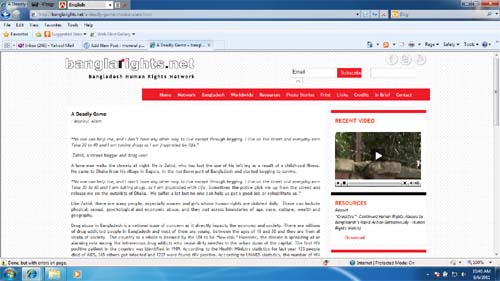
Bangla Rights | Publication

No one can help me, and I don’t have any other way to live except through begging. I live on the street and everyday earn Taka 30 to 40 and I am taking drugs as I am frustrated by life.”

-Zahid, a street beggar and drug user
A lame man walks the streets at night. He is Zahid, who has lost the use of his left leg as a result of a childhood illness. He came to Dhaka from his village in Bagura, in the northern part of Bangladesh and started begging to survive.

No one can help me, and I don’t have any other way to live except through begging. I live on the street and everyday earn Taka 30 to 40 and I am taking drugs, as I am frustrated with life. Sometimes the police pick me up from the street and release me on the outskirts of Dhaka.  We suffer a lot but no one can help us get a good job or rehabilitate us.”

Like Zahid, there are many people, especially women and girls whose human rights are violated daily.  These can include physical, sexual, psychological and economic abuse, and they cut across boundaries of age, race, culture, wealth and geography.

Drug abuse in Bangladesh is a national issue of concern as it directly impacts the economy and society. There are millions of drug-addicted people in Bangladesh and most of them are young, between the ages of 18 and 30 and they are from all strata of society.  The country as a whole is deemed by the UN to be “low-risk.” However, the disease is spreading at an alarming rate among the intravenous drug addicts who reuse dirty needles in the urban slums of the capital. The first HIV positive patient in the country was identified in 1989. According to the Health Ministry statistics for last year 123 people died of AIDS, 365 others got infected and 1207 were found HIV positive. According to UNAIDS statistics, the number of HIV-positive drug users more than doubled between 2001 and 2005. Health experts warn that the risk of an epidemic is increased by that fact that many of the addicts also admit paying for sex and only 10 percent say they always use a condom.

Most of the addicts are young, homeless and unemployed. Some of them don’t know anything about the diseases they have. Frustrated with lives they have turned to drugs. When you talk to them you realize they are just waiting for death because they have nothing else to do.

Artist statement

“A deadly game” is my self-photography project. My work started many years ago when I got to know about HIV/AIDS. As a photojournalist, I find the street drug users suffer more and face more problems as they do not know their basic rights.  At the same time they don’t know enough about diseases to be concerned about them.

My main focus is on the street drug user is to show their actual condition in a humane way . At the same time, I also would like our society to see the drug users and to respect their human rights through my photo story.

Note: Recently Bangladesh Human Rights Networks, banglarights.net published my Photo Story, A Deadly Game to their on line publication. Please visit on the following link pages

Link: http://banglarights.net/a-deadly-game-moniul-alam.html
Argentina Soccer Team in Dhaka

© Monirul Alam

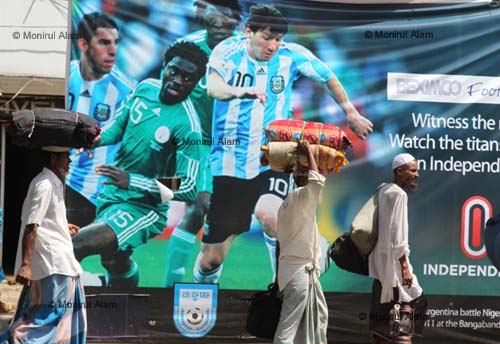
 A pedestrians cross on the road is in Argentina football team captain Lionel Messi and other football players portraits display in the Dhaka city. The Argentina national football team arrived in Dhaka Monday morning ahead of their international friendly against Super Eagle Nigeria scheduled on Tuesday 6 September at Bangabandhu stadium.Dhaka September 2011. © Monirul Alam

Indian Prime Minister visit in Bangladesh

© Monirul Alam

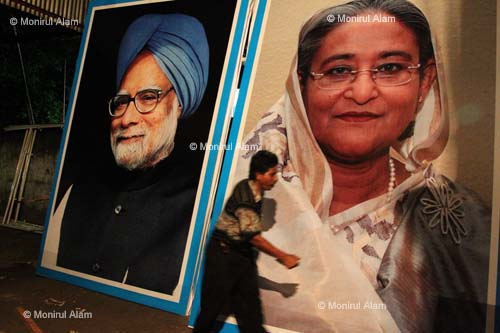
 A Bangladeshi painter prepares a digital banner as a portrait of Indian Prime Minister Manmohan Singh’s and Bangladesh Prime Minister Sheikh Hasina, which are displayed in the city during of Singh’s visit in Dhaka, Bangladesh. Singh is scheduled to visit Bangladesh on 6 September 2011. Dhaka September 2011. © Monirul Alam

Turn Human Sea | Eid Journey in Bangladesh

Thousand of Bangladeshi people along with mass garment workers are leaving from the capital of Dhaka, on Tuesday. They are going to their home town is in celebrating Eid-ul-Fitar. Eid-ul-Fitar is the largest Muslim’s religious festival. After the whole month of fasting in Ramadan the Muslim’s around the world will be celebrate their religious festival.

A number of home bound people are waiting in a airport railway station for train. But the train is not to come on time, because of rush schedule and mismanagement said a passenger Ahmed, who are waiting for train, he around on the station an one and half hour’s for waiting Rangpure Express.

When the train arrives is in station, it’s already overcrowded look like a human sea. Within a few minutes people rush on the train and agitate each other when they ride on the train roof. A garments worker, Shafali Bagum said, we are straggling on the way of our risky  journey, but we are finally happy to go to our home and celebrate Eid-ul-Fitar with our loved  ones.”  Reports, monirul alam, Dhaka, Bangladesh. 30 September 2011.

Nation Celebrated Eid-ul-Fitar | Bangladesh

© Monirul Alam

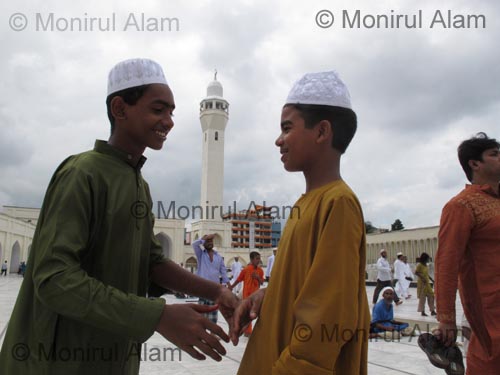
 After the Eid Jammat (congregation)  children’s exchange their love in front of Baitul Mukarram mosque. Eid-ul-Fitr, the biggest religious festival of the Muslims, is being celebrated across the country on Wednesday 31 August .

© Monirul Alam


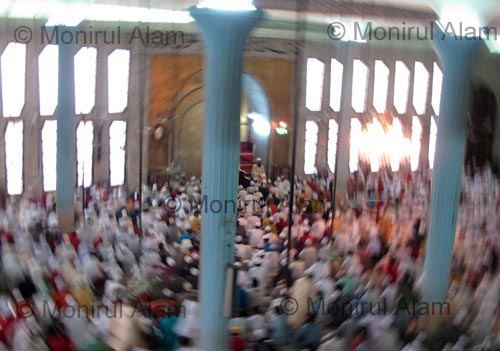
After a month-long fasting, Muslims sought divine blessings, peace, progress and prosperity in Eid congregations across the country. The main jamaat held at the National Eidgah on the High Court premises in the city at 8:30am. The three-day public holiday on this occasion started Tuesday. Dhaka August 2011. © Monirul Alam