Copy Right Notice:
All images and text in this site is copyrighted. http://monirul.photoshelter.com/ Please don’t use any image without written permission. Please contact witnessphoto@gmail.com
Copy Right Notice:
All images and text in this site is copyrighted. http://monirul.photoshelter.com/ Please don’t use any image without written permission. Please contact witnessphoto@gmail.com
Copy Right Notice:
All images and text in this site is copyrighted. http://monirul.photoshelter.com/ Please don’t use any image without written permission. Please contact witnessphoto@gmail.com
Copy Right Notice:
All images and text in this site is copyrighted. http://monirul.photoshelter.com/ Please don’t use any image without written permission. Please contact witnessphoto@gmail.com
Copy Right Notice:
All images and text in this site is copyrighted. http://monirul.photoshelter.com/ Please don’t use any image without written permission. Please contact witnessphoto@gmail.com
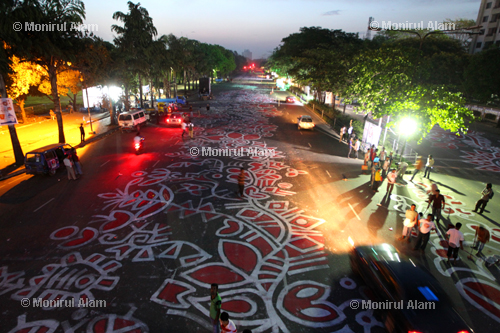
14 April 2012 Dhaka, Bangladesh- People of all walks of life late into the night watch university students paint the largest motif ( alpana) in the world on both sides of the Manik Mia Avenue in the capital. On the eve of Bangla New Year 1419, five eminent artists coordinated the 350,000 square feet motif representing the folk culture of Bangladesh. © Monirul Alam
Note: See more picturs please visit : http://www.zumapress.com/search_results.html?HEADLINE=Bangla+New+Year+2012
The family is both the fundamental unit of society as well as the root of culture. It is a perpetual source of encouragement, advocacy, assurance, and emotional refueling that empowers a child to venture with confidence into the greater world and to become all that he can be. . . MARIANNE E. NEIFERT
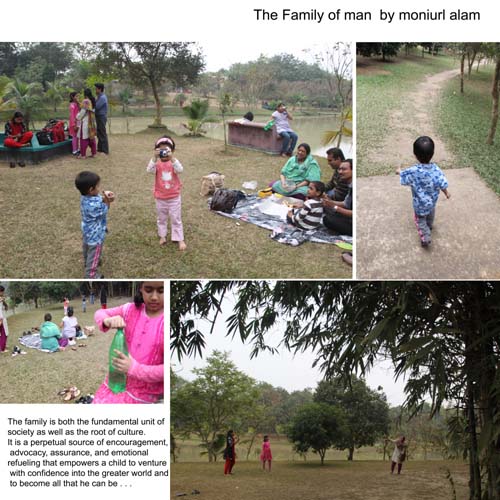
07.Jan.2012.Pubile Kaliganj.Bangladesh- A Bangladeshi middle class family takes a pleasure time with their family picnic tour outskirt of Dhaka Punail Kaligonj .Number of Bangladeshi family take a short tour in their weekend holyday especially in winter season. © Monirul Alam
“No one can help me, and I don’t have any other way to live except through begging. I live on the street and everyday earn Taka 30 to 40 and I am taking drugs as I am frustrated by life.”
-Zahid, a street beggar and drug user
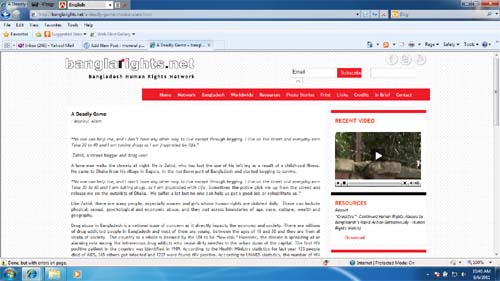
A lame man walks the streets at night. He is Zahid, who has lost the use of his left leg as a result of a childhood illness. He came to Dhaka from his village in Bagura, in the northern part of Bangladesh and started begging to survive.
“No one can help me, and I don’t have any other way to live except through begging. I live on the street and everyday earn Taka 30 to 40 and I am taking drugs, as I am frustrated with life. Sometimes the police pick me up from the street and release me on the outskirts of Dhaka. We suffer a lot but no one can help us get a good job or rehabilitate us.”
Like Zahid, there are many people, especially women and girls whose human rights are violated daily. These can include physical, sexual, psychological and economic abuse, and they cut across boundaries of age, race, culture, wealth and geography.
Drug abuse in Bangladesh is a national issue of concern as it directly impacts the economy and society. There are millions of drug-addicted people in Bangladesh and most of them are young, between the ages of 18 and 30 and they are from all strata of society. The country as a whole is deemed by the UN to be “low-risk.” However, the disease is spreading at an alarming rate among the intravenous drug addicts who reuse dirty needles in the urban slums of the capital. The first HIV positive patient in the country was identified in 1989. According to the Health Ministry statistics for last year 123 people died of AIDS, 365 others got infected and 1207 were found HIV positive. According to UNAIDS statistics, the number of HIV-positive drug users more than doubled between 2001 and 2005. Health experts warn that the risk of an epidemic is increased by that fact that many of the addicts also admit paying for sex and only 10 percent say they always use a condom.
Most of the addicts are young, homeless and unemployed. Some of them don’t know anything about the diseases they have. Frustrated with lives they have turned to drugs. When you talk to them you realize they are just waiting for death because they have nothing else to do.
Artist statement
“A deadly game” is my self-photography project. My work started many years ago when I got to know about HIV/AIDS. As a photojournalist, I find the street drug users suffer more and face more problems as they do not know their basic rights. At the same time they don’t know enough about diseases to be concerned about them.
My main focus is on the street drug user is to show their actual condition in a humane way . At the same time, I also would like our society to see the drug users and to respect their human rights through my photo story.


Note: Recently Bangladesh Human Rights Networks, banglarights.net published my Photo Story, A Deadly Game to their on line publication. Please visit on the following link pages
Link: http://banglarights.net/a-deadly-game-moniul-alam.html
 MONIRUL ALAM