“Photography has been a tool to discover stories from people and share it to the world. It is a job with humanity and responsibility.” – Abir Abdullah / EPA Photojournalist
That time is late afternoon, a beautiful light ray fall on the destruction old building in Nepal ! What’s going on here ? Why photojournalist taking pictures in this ruins building ? Where it’s people ? Yes, the answer is still one; An Earthquake ! It registered 7.8 on the richter scale. Recently the whole world becomes speechless to see the destruction of human loss and historical property in Nepal. A 55 seconds quake killed more than 8,0000 people injured ore than 18,000 in different parts of Nepal.
Number of international media was there to cover this horrified destruction of human lives and property. A Bangladeshi noted photojournalist Abir Abdullah one of them to cover it and his bring back to made a solo photography exhibition title “Nepal-Resilience and Reasons held this week ( 5-11 June 2015 ) at Gallery Chitrak in the capital of Dhaka, Bangladesh. About his exhibition Abir said, The quake was felt as far as some places in India and Bangladesh, is important to aware our people to prepare for such calamities in a country like Bangladesh where building are built without confirming to the building codes, erecting unplanned structure and what not. At the same I would like to show solidarity of Bangladeshi people with towards the beautiful people and the country of Nepal.
Abir arrived in Nepal on the second day of the quake to cover the devastation. He witnessed the fear and tear of the people who lost their loved ones,families and neighbors. He travelled major affected areas documenting the catastrophe of nature and the struggle of the surviving people. His eyes and his camera recorded once again how defenseless we humans an against the forces of nature. This documentary evidence shown the resilience of this friendly people of Nepal started rebuilding their lives again.
Biography
Abir Abdullah is an epa photographer based in Bangladesh.
Abir Abdullah was born in 1971. Started photography career in 1996 at Drik Picture Library, Dhaka, Bangladesh. He is currently working for the European Pressphoto Agency (EPA) as Bangladesh correspondent.
Photographs published in Blink, Time, Newsweek, Der Speigel, New Internationalist, Guardian, International Herald Tribune, Asiaweek, Elmundo, Stern, Geo etc.
Abir’s sensitive work on environmental issues is especially notable. His numerous awards include Mother Jones, NPPA, Days Japan, and Islamic Unity-Iran.
He completed the three year seminar ‘Pleasure of Life’ assigned and supported by World Press Photo Foundation Netherlands. His photographs have been exhibited in Europe, South America, Asia and the U.S. His work has been published in the World Press Photo book New Stories and Phaidon Press’ Blink.
Abir Abdullah also jury in China International Press Photo Contest in China in 2008. World Press Photo Contest in Amsterdam in 2011. His web site http://www.abirphoto.com
Copy Right Notice:
All images and text in this site is copyrighted. Please don’t use any image without written permission. ART WORK is currently for sale. Please contact monir4@yahoo.com
Copy Right Notice:
All images and text in this site is copyrighted. Please don’t use any image without written permission. ART WORK is currently for sale. Please contact monir4@yahoo.com
The Conflict between tiger and human has to a new level in the mangrove forest of the Bangladesh.Thirty people were killed by tigers last year and three tigers by people. Since Cyclone Sidr [November 2007] and Cyclone Aila [May 2009], when 1,000 people who lived near to the water had their homes flooded and were forced to move inland. Hungry people now risk facing a tiger attack everyday when they go into the forest looking for food. On February 6 in southern Sundarban. A Bengal tiger had just killed a 40-year-old woodcutter called Mabud, deep in the mangrove forest when he was collecting firewood in the area of Char-shesher. One villager told me ‘We enter the jungle searching for food and the tiger kills us . . . the tiger comes to our village, we kill the tiger’.
I took these photos on February 6 in southern Sundbaran . A Bengal tiger had just killed a 40-year-old woodcutter called Mabud, deep in the mangrove forest when he was collecting firewood in the area of Char-Shesher. One of his fellow woodcutters, Abul Sarder, told me that five of them entered the jungle to collect firewood and suddenly a tiger attacked them. ‘When we had escaped we realised that Mabud had not. We tried to save him but failed to fight off the tiger.’
On the way of my office long time I standing near the Mintu road with my motorbike causes huge traffic jam. A bas contractor insisting me-ride your motorbike on the footpath and safe your time. He said, bhai footpath re upper deya jan, boya takle shomoy nosto hoibo. I think as a responsible person I don’t go the wrong way . . .
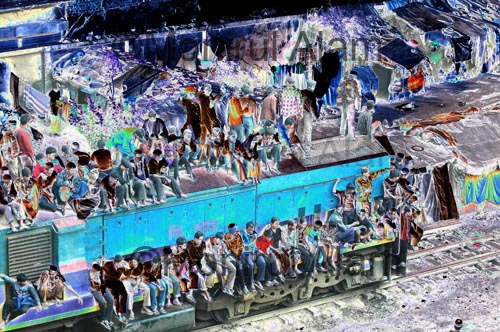
Dhaka. Human Train Copy Right:Monirul Alam
Within a few minute’s I see most of the motorbike rider- ride their motorbike on the footpath- like parent with his kids,security forces,Journalist and many more. After while a contractor smiling for me, and said how foolish you are !
In the day time all street are occupied and gridlock by the bus,private car, rickshaw street hacker. Political parties and other organization doing their regular activities on the busy street without concern law and other people’s right.
Dhaka city people are now crazy. If your could closely observe than you see within a minute more incident is happening even that each other beat of them for funny things, every day of their daily chats.
Lawlessness, respecting each other and dignity is gradually lost form the people’s life. It is establish that We lost our believe. We all are busy and mad crazy going faster and faster- but the result in ZERO.
On that days I also covering an assignment at Faculty of Fine Arts ( Charukola Dhaka University) An eminent Japanese sculptor SETSU SUZUKI for his exhibition opening. He said, my first visit I see huge number of people live in the dhaka city. He also said my HUMAN TOWER installation is more relevant for the Bangladeshi people. I think as a foreign artiest within a short time to read our society.
 MONIRUL ALAM