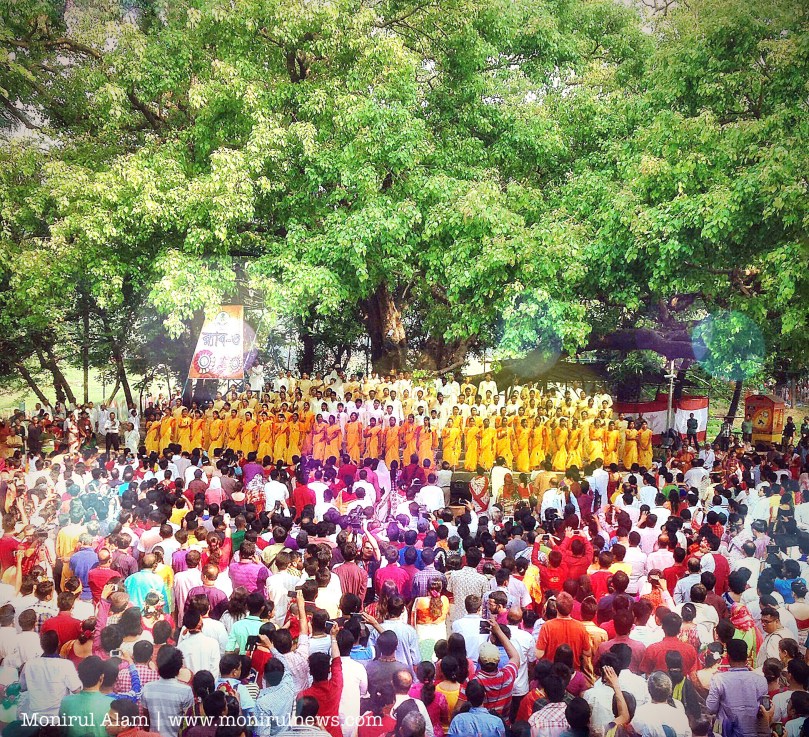
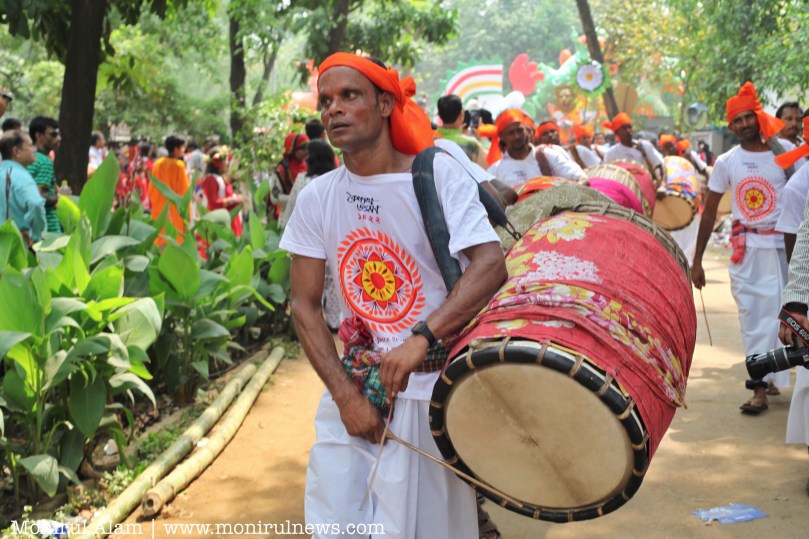
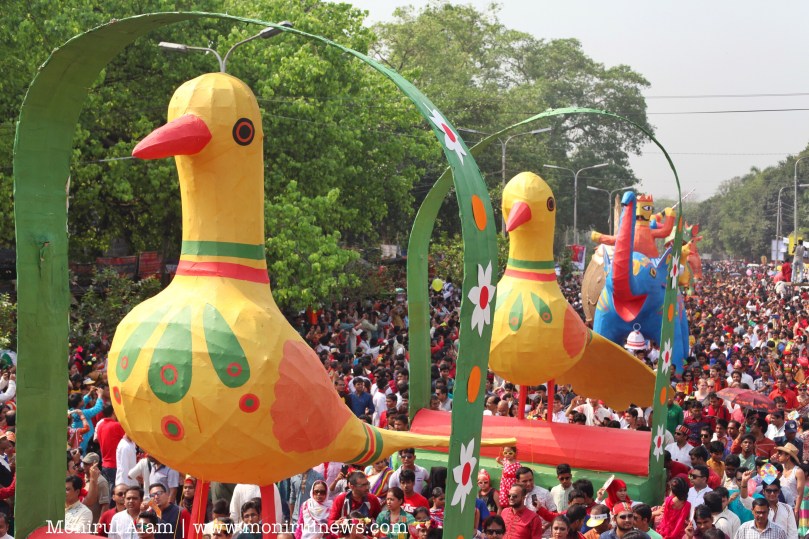
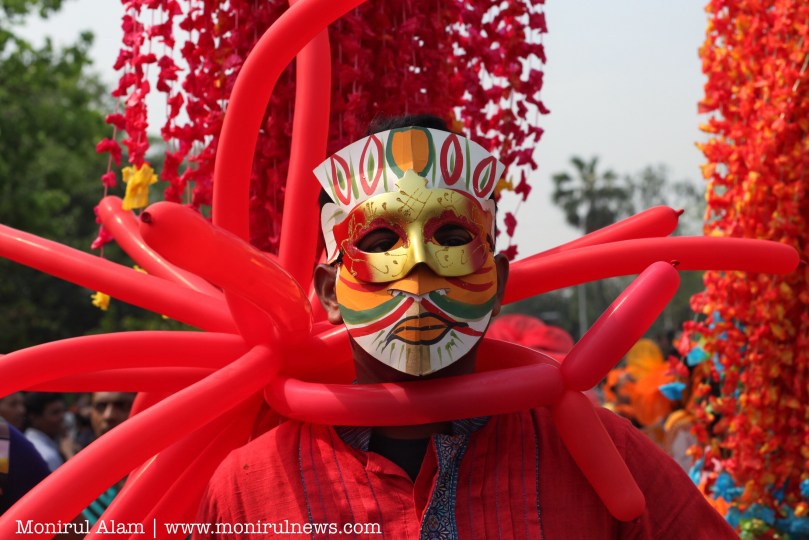
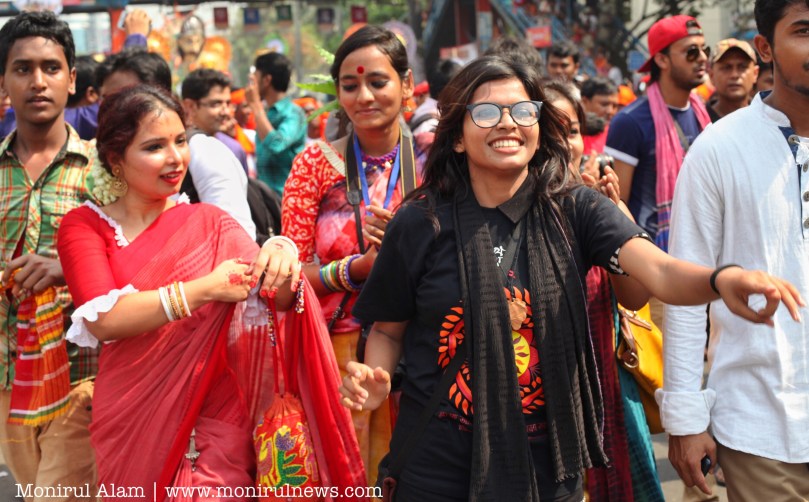
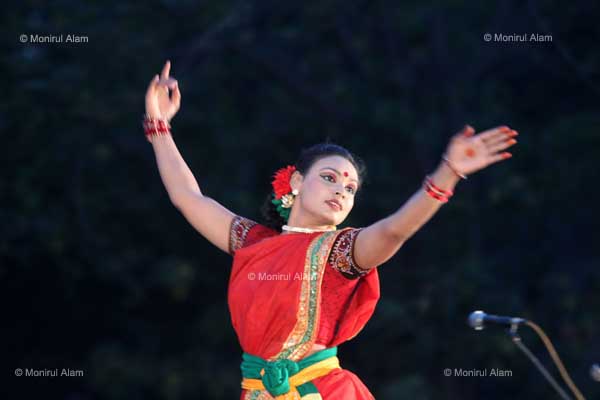
14 April 2015 Dhaka, Bangladesh. The nation began celebrating Pahela Baishakh the first day of Bangla month 1422, with various programs since the early morning on 14 April 2015 Dhaka Bangladesh. Cultural organization Chhayanat welcomed the new year with Tagore’s songs and traditional music at Ramna Batamul, attended by tens of thousands of people attired with traditional attires on the occasion. Cultural activists, artists and students of Faculty of Fine Arts held the Mongol Shova Jatra, the mass rally, with the theme ‘Onek Alo Jalte Hobe Moner Ghore Let’s light thousand lights in the darkness of our heart’ in downtown Dhaka, Bangladesh.It’s day for friends and family,wearing colorful dress and having traditional food. Photo by Monirul Alam
Copy Right Notice:
All images,videos, ART and text in this site is copyrighted. http://www.monirulnews.com Please don’t use any image without written permission. Please contact witnessphoto@gmail.com
Every Day Life 14 April 2015 The nation began celebrating Pahela Baishakh the first day of Bangla month 1422, with various programs since the early morning on 14 April 2015 Bangladesh. Cultural organization Chhayanat welcomed the new year with Tagore’s songs and traditional music at Ramna Batamul, attended by tens of thousands of people attired with traditional attires on the occasion. Cultural activists, artists and students of Faculty of Fine Arts held the Mongol Shova Jatra, the mass rally, with the theme ‘Onek Alo Jalte Hobe Moner Ghore Let’s light thousand lights in the darkness of our heart’ in downtown Dhaka, Bangladesh. Photo by Monirul Alam @meghmonir
Copy Right Notice:
All images,videos, ART and text in this site is copyrighted. http://www.monirulnews.com Please don’t use any image without written permission. Please contact witnessphoto@gmail.com
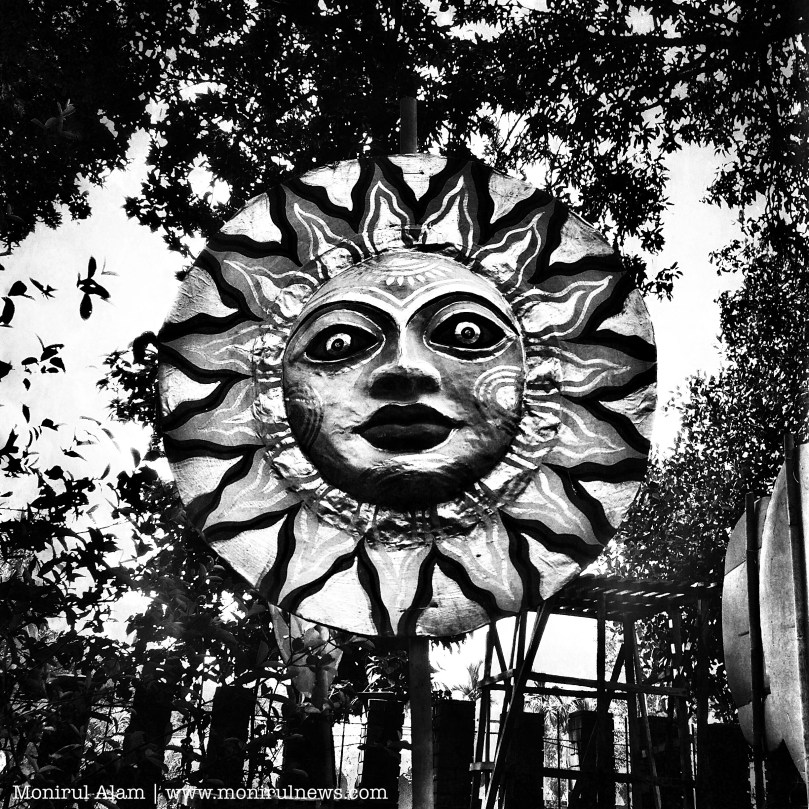
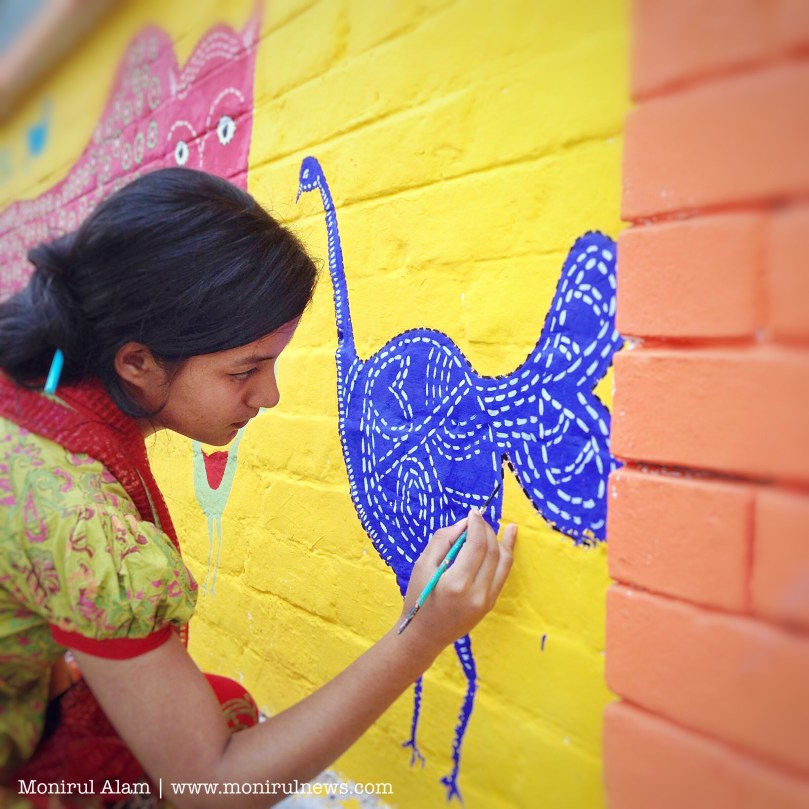
Every Day Life 12 April 2015 Students of Dhaka University’s Institute of Fine Arts on Sunday prepare to celebrate Pahela Boishakh, the first day of Bangla calendar, on Apr 14. Mughal Emperor Jalaluddin Muhammad Akbar, the renowned grandson of Zahiruddin Muhammad Babur, the 3rd Mughal Emperor, introduced the Bangali Calender. For relatively easier tax collection, Akbar changed the practice of agricultural tax collection according to the Hijri calendar. He ordered an improvement because the Hijri calendar, being lunar, did not agree with the harvest sessions and eventually the farmers faced severe difficulties in paying taxes out of season.Photo by Monirul Alam @meghmonir
In the story, a popular Bangladeshi comic character called Meena (girl), desire for an education but initially has to stay at home to help with the housework. But by the end of the story, Meena’s relatives realize the value of education and the earnest young girl heads to school with her younger brother. The focus on education is evident among policymakers across Bangladesh who are taking measures to achieve a 100 per cent literacy rate within the next decade.
As per the latest literacy survey report of Bangladesh Bureau of Statistics (BBS), the country’s literacy rate of the population aged above 15 reached 59.82 per cent while the illiteracy rate is 40.18 and the literacy of women is 55.71 per cent.
The education system and structure of Bangladesh has three major stages-primary, secondary and higher educations. Primary education is a 5-year cycle while secondary education is a 7- year one with three sub-stages: 3 years of junior secondary, 2 years of secondary and 2 years of higher secondary. The private schools also receive strong financial support from the state. The tertiary education (3-5 years) is provided through universities (31 public and 51 private universities) and affiliated colleges under supervision of University Grants Commission. Establishment of private universities has gained momentum in recent years. At all levels, students can choose the medium of education from Bangla or English.
The constitution is the fundamental law of the country it serves as a framework of all others laws. According to the Bangladesh Constitution article 17 Free and compulsory education. The State shall adopt effective measures for the purpose of –
a) establishing a uniform, mass-oriented and universal system of education and extending free and compulsory education to all children to such stage as may be determined by law; b) relating education to the needs of society and producing properly trained and motivated citizens to serve those needs; removing illiteracy within such time as may be determined by law.
This project was a challenge for me as I had to document the subject in a different way than I did before and continue in upcoming days. I feel this challenge has taken the whole project to a new level.
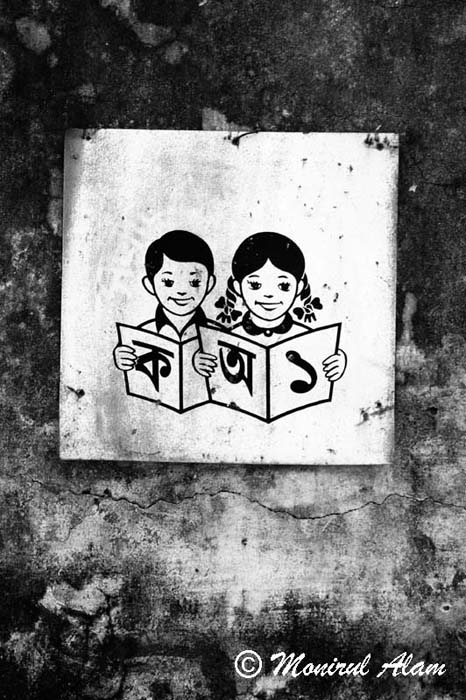
An artist makes a school education logo which is display on the school wall its logo is widely use in Bangladesh. As per the latest literacy survey report of Bangladesh Bureau of Statistics (BBS), the country’s literacy the literacy rate of the population aged above 15 reached 59.82 per cent while the illiteracy rate is 40. PHOTO Nov. 18, 2009 Dinajpure Bangladesh.
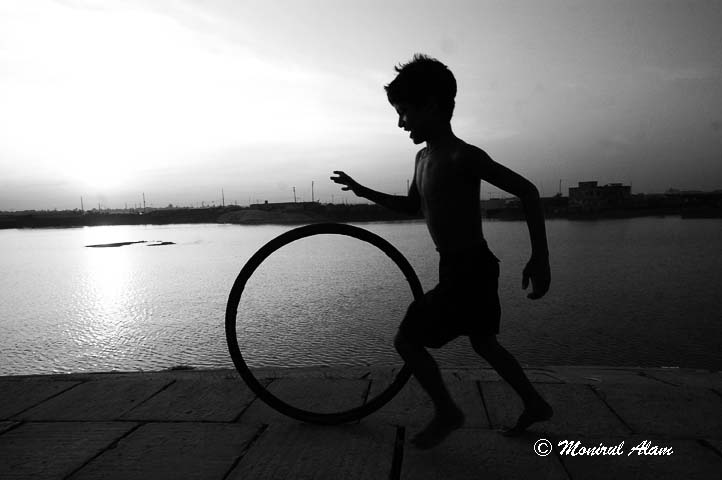
A Bangladeshi child play with his rickshaw tires on the street of Dhaka after he finished his school, Prime Minister Sheikh Hasina says her government has undertaken necessary plans to free the country of illiteracy by 2014. PHOTO Oct. 27, 2005 Dhaka Bangladesh.
Copy Right Notice:
All images and text in this site is copyrighted. Please don’t use any image without written permission. ART WORK is currently for sale. Please contact monir4@yahoo.com
Copy Right Notice: All images and text in this site is copyrighted. Please don’t use any image without written permission. Please contact monir4@yahoo.com
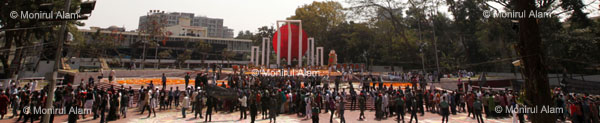
Millions of Bangladeshis have placed wreaths at hundreds of Shaheed Minars across the country to pay rich tributes to the language movement martyrs of 1952. The country is observance of International Mother Language Day on Tuesday, popularly known as Martyrs’ Day (Shaheed Dibas). The memorial for the annual traditional remembrance of those killed when police fired on campaigns on this day, who were demanding Bengali be declared as one of the state languages of what was then Pakistan.

 MONIRUL ALAM